Weather Over the Horizon: VOLMET
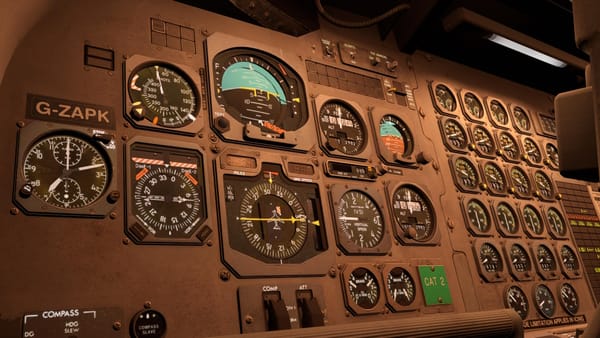
Imagine this: You're mid-Atlantic in a 747-200. There's a few hours before you reach the other side of the great blue expanse. You've got your primary and secondary H.F. frequencies dialled in, and New York Radio has copied your last position report. For want of abundant preparedness, and faced with an excess of time remaining, you review the planned arrival. It'd be a very different picture, depending on the runway direction — best we check the weather, right, Captain?
Nowadays, availing yourself of the latest weather is usually trivial. In our 747-200 over the ocean, the only way we can get any information from land is by H.F. radio; so, how ought we to get the weather data we want?
Volmet, that's how.
Pardon my French, it's a (Francophone) shorthand for the service that gives weather information to aircraft in flight.
In decades past, such as the time period when 747-200s were still dashing around in droves, Volmets were ubiquitous. The world has moved on since then, but a few examples are still buzzing around the airwaves.
Volmets have a simple core function: Allow aircraft in flight to obtain up-to-date METAR/TAF data, by transmitting them over radio; somewhat akin to ATIS'.
Shannon & Gander
Although V.H.F. Volmets are more numerous in Europe, Shannon Volmet is the legendary H.F. Volmet keeping long-haulers around the world appraised of the prevailing and forecast weather conditions for all the continent's major aerodromes and terminal areas.
Shannon is a one-stop-shop for all of Europe, and nobody else is competing for airtime, so Shannon's scheduled transmissions run around-the-clock, without any intervals. The same was true for Gander Volmet, Shannon's Canadian counterpart, until its demise was finally met in 2025.
Lively in Asia
Volmets on H.F. remain most plentiful in Asia, and none of them are so lucky to have a whole frequency to themselves.
On the SEA-1 Volmet network, each station gets a five-minute slot, repeating every half-hour. Each station transmits on the same two frequencies, one higher and one lower, each at their scheduled times.
The five-minute block rolls around, starting at :00 with Australian, then Kolkata, then Bangkok, then Karachi, then Singapore, then Mumbai; before rolling back around to the start at :30.
Some stations alternate the contents of their schedule to fit everything in over an hour. For example, Singapore needs to transmit the lengthy forecasts for both Kuala Lumpur and Jakarta, in addition to their own, but it does so one-at-a-time: the Kuala Lumpur forecast in the :20 slot, and then Soekarno-Hatta in the :40 slot.
Bangkok, on the other hand, transmits the same schedule every time; and is known to 'speed up' playback of the recorded message when necessary. Sometimes, it cuts itself off at the end of the timeslot to prevent running over.
Quicker than Pigeons, Slower than Satellites
You could say: It works. And it does — remarkably well, in fact; although the skill of navigating shortwave bands is becoming less prevalent, and more refined amongst professional (or amateur) radio operators, rather than professional plane drivers burdened with the unceremonious task of working the radios. As I alluded, it's becoming less necessary as time progresses, anyway.
It's not always as neat as it appears on paper, either. Differences in timekeeping (yes, still) mean that some stations start and stop transmitting slightly earlier or later than whoever comes next, consequently having two overlapping Volmets yapping over each other for a non-zero amount of time — with our luck, the overlap will cease right after the exact airport we needed.
On the other hand, the problem of overlapping stations may be more- or less problematic depending on a key factor: Signal propagation.
Readable? Sure.
Signal propagation is, in short, the entire reason the aviation industry keeps its H.F. radios around. It's an excellent back-up, if nothing else; and it's useful over very long distances — potentially world-wide coverage at very low power, if graced with optimal conditions.
With sub-optimal conditions, however, the transmission could be limited to a much shorter workable distance, or the band may simply be considered "dead" — go find another frequency.
The conditions are primarily influenced by the position of the Sun, and the prevailing Space Weather, i.e. the Sun's mood. There's an old adage to remember: Sun Up, Freq Up / Sun Down, Freq Down. Essentially: lower frequencies perform better at night, and higher frequencies perform better during daylight. The effects of propagation are heightened in the time surrounding sunrise and sunset.
The point: On the same frequency, you may find one station to be much easier to receive than the other. If you're lucky, it'll be the station you actually want to catch.
Conclusion
When you catch yourself reaching for convenient, digitally-delivered weather data, spare a thought for those who came before you, and who did so armed nothing but with 100% pure nineteenth century.
More helpfully, keep an eye on the Volmet stations, and on the H.F. band. It may seem — and be — painful, but it's the kind of old-school kit that might just be the thing that can get you out of a pinch when nothing else can.
If you want to hear Volmet in action, I have a video demonstrating the Asia Volmet network mentioned in this article: